The honest cost of hiring a Shopify developer in India in 2026
Most "Shopify developer pricing in India" pages hide the numbers or pad them with consultant fog. Here are the actual ranges — freelancer, solo operator, agency, Shopify Plus partner — in INR and USD, with what each tier includes and where the lines blur.


Listen to this article
The honest cost of hiring a Shopify developer in India in 2026
The short answer
- Hiring a Shopify developer in India in 2026 costs ₹50,000 to ₹30 lakh for a single project, depending on which of four tiers you buy from.
- Tier 1, marketplace freelancer: ₹800–2,500 an hour ($10–30), projects ₹50,000–₹2,50,000 ($600–3,000).
- Tier 2, senior solo operator: ₹2,500–6,000 an hour ($30–70), projects ₹2,50,000–₹15,00,000 ($3,000–18,000).
- Tier 2 fits brands at ₹15 lakh to ₹2 crore monthly revenue that need the whole implementation owned by one accountable person.
Free, no pitch
Already holding a quote? I’ll tell you if it’s fair.
Send me the scope, timeline and price you were given. I’ll read it against the numbers on this page and tell you what looks right, what’s missing, and which line items usually turn into change requests later. If the quote is good, I’ll say so — even when it isn’t mine.
Here's the whole thing in three sentences. Hiring a Shopify developer in India in 2026 costs anywhere from ₹50,000 to ₹30 lakh for a single project depending on who you hire and what you ask for. The range is real, not lazy — there are four distinct tiers of seller in this market and they're priced for four different shapes of buyer. This post strips out the fog so you can match the tier to the brand without overpaying for an org chart you don't need.
I'm writing this because almost every other "Shopify developer cost in India" page either hides the numbers behind a "request a quote" CTA or lists them so wide ("₹50,000 to ₹50 lakh") that they're useless. The wider the range, the less the page is doing for you. Let me try the opposite.
The four tiers, with the fog stripped out
There are four distinct tiers of Shopify developer in the Indian market in 2026. The pricing gaps between them are real, and the gaps inside each tier are smaller than the gaps between tiers.
Tier 1 — Marketplace freelancer. Found on Upwork, Fiverr, or Indian freelance boards. Usually one to three years of Shopify experience. Hourly ₹800 to ₹2,500 ($10 to $30 USD). Project rates ₹50,000 to ₹2,50,000 ($600 to $3,000). Best for: discrete tasks with a clear brief. Theme tweak, single feature, app config.
Tier 2 — Solo operator / senior freelancer. Three to seven years of D2C Shopify experience, owns their own positioning, usually a portfolio of named brands. Hourly ₹2,500 to ₹6,000 ($30 to $70). Project rates ₹2,50,000 to ₹15,00,000 ($3,000 to $18,000). Best for: brands at ₹15 lakh to ₹2 crore monthly revenue that need the full Shopify implementation owned by one accountable person. This is my tier.
Tier 3 — Boutique agency. Five to fifteen people. Mix of designers, developers, and a project manager. Hourly ₹4,000 to ₹8,500 ($50 to $100), often blended across the team. Project rates ₹5,00,000 to ₹25,00,000 ($6,000 to $30,000). Best for: brands that want a single vendor for both design and dev, with someone managing the timeline.
Tier 4 — Shopify Plus partner / enterprise agency. Twenty-plus people. Multiple teams. Verified Shopify Plus partner status. Hourly ₹6,000 to ₹12,000+ ($75 to $145+). Project rates ₹10,00,000 to ₹1 crore+ ($12,000 to $120,000+). Best for: brands above ₹2 crore monthly revenue, or international brands moving onto Shopify Plus from another platform.
These ranges are conservative and I'd defend them as the working numbers in 2026. Anyone quoting you outside these bands — especially below the Tier 1 floor — is either misrepresenting their experience or signalling they don't know what their work costs.
The hourly rate comparison
| Tier | Hourly (INR) | Hourly (USD) | Who actually does this work |
|---|---|---|---|
| Marketplace freelancer | ₹800 – ₹2,500 | $10 – $30 | The freelancer themselves |
| Solo operator | ₹2,500 – ₹6,000 | $30 – $70 | The operator themselves |
| Boutique agency | ₹4,000 – ₹8,500 | $50 – $100 | A junior or mid developer on the team |
| Shopify Plus partner | ₹6,000 – ₹12,000+ | $75 – $145+ | A mix of senior and junior developers, billed at blended rate |
Two things to notice. First, the hourly rates overlap between Tier 2 and Tier 3 — a senior solo operator and a junior developer at a boutique agency can cost roughly the same per hour. The difference is whose hours you're buying. The solo operator's hours are senior end-to-end. The agency's are tiered and often padded with PM and account management. Second, the Tier 4 rate is a blended number, not what the senior developer on the project actually charges — that person internally might cost the agency ₹3,500/hr.
Sources: Clutch India Shopify directory listings publish hourly bands from under $25 to $149 (clutch.co/in/developers/shopify); 7 of 8 firms on Clutch's Delhi Shopify SEO listing self-report under-$25 or $25–$49 brackets (clutch.co/in/seo-firms/shopify/delhi). Upwork's hire-a-Shopify-developer page shows global ranges that India-based freelancers slot into the lower half of.
The project rate comparison
This is the more useful table. Hourly is a billing mechanism; project rates are what the brand actually writes the cheque for.
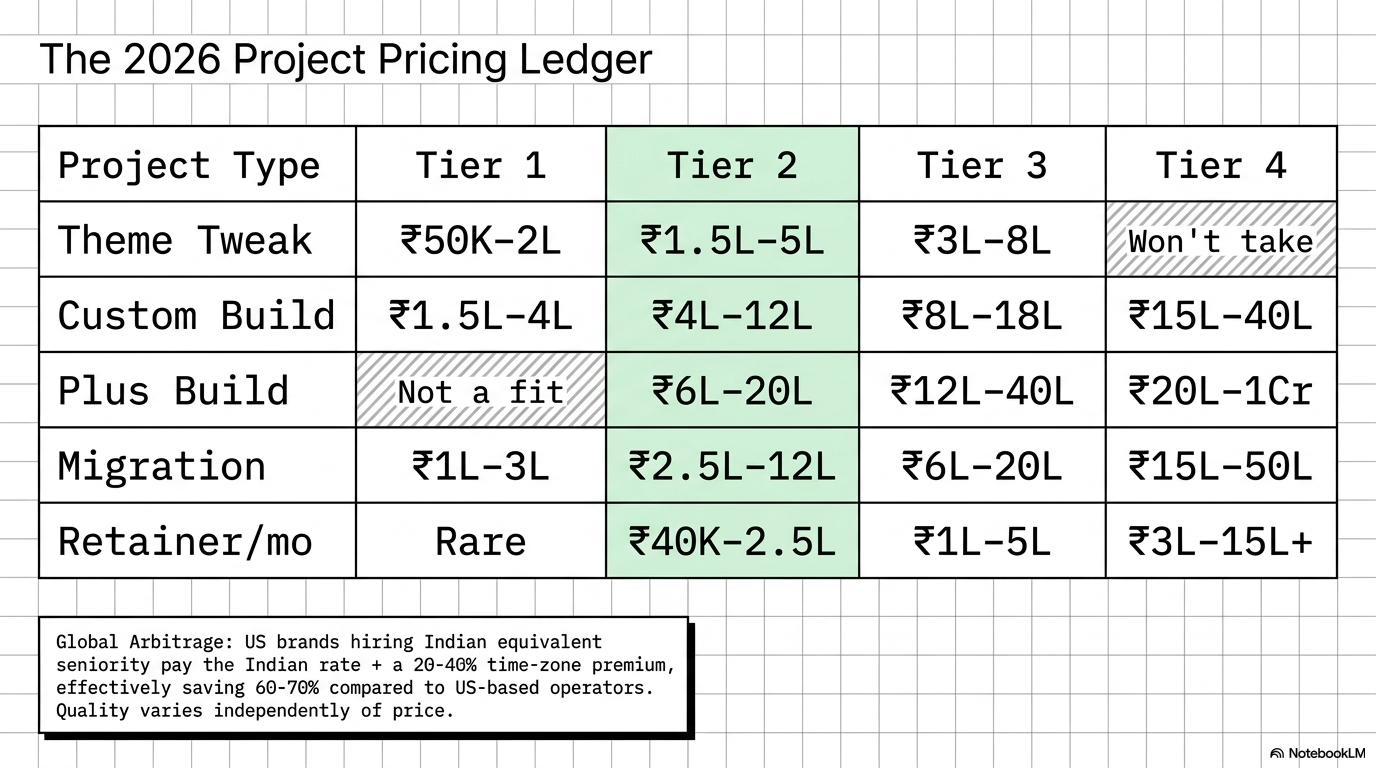
| Project type | Marketplace freelancer | Solo operator | Boutique agency | Shopify Plus partner |
|---|---|---|---|---|
| Theme tweak / single feature | ₹50,000 – ₹2,00,000 | ₹1,50,000 – ₹5,00,000 | ₹3,00,000 – ₹8,00,000 | Usually won't take it |
| Custom theme build | ₹1,50,000 – ₹4,00,000 | ₹4,00,000 – ₹12,00,000 | ₹8,00,000 – ₹18,00,000 | ₹15,00,000 – ₹40,00,000 |
| Shopify Plus build | Not a fit | ₹6,00,000 – ₹20,00,000 | ₹12,00,000 – ₹40,00,000 | ₹20,00,000 – ₹1 crore |
| Migration (Woo/Magento → Shopify) | ₹1,00,000 – ₹3,00,000 | ₹2,50,000 – ₹12,00,000 | ₹6,00,000 – ₹20,00,000 | ₹15,00,000 – ₹50,00,000 |
| Monthly retainer | Rarely retainer-based | ₹40,000 – ₹2,50,000/mo | ₹1,00,000 – ₹5,00,000/mo | ₹3,00,000 – ₹15,00,000+/mo |
The numbers above assume Indian buyer, Indian seller. If you're an Indian brand hiring a US-based developer of equivalent seniority, multiply Tier 2 and Tier 3 numbers by roughly 2.5 to 3. If you're a US brand hiring an Indian developer of equivalent seniority, you'll pay closer to the Indian numbers plus a 20 to 40 percent premium for time-zone overhead.
Here's a recent example. Bloom Bodysuits, a US-based D2C brand selling women's bodysuits, came to me for a custom Shopify theme built from scratch. I quoted ₹1,70,000 (about $2,000) for the build — custom theme architecture, mobile-first PDP variants, Klaviyo integration, Core Web Vitals tuning, conversion-rate decisions baked into the layout. Scoped in writing before any work started. They moved onto a ₹65,000/month retainer afterward, where I now handle SEO, AEO, and ongoing iteration on the store. The store is doing 450 to 750 orders a month, with revenue compounding around 22 percent month over month. The same scope quoted at the boutique agency tier above would have started at ₹6 to ₹8 lakh — most of the difference is project management I'd be doing in either case.
What's actually included at each price point
Pricing without scope is theatre. Here's roughly what you should expect at each tier for a typical custom Shopify theme build.
Marketplace freelancer (₹1,50,000 – ₹4,00,000): Theme from a starter, branding applied, products imported, basic apps installed. No custom development beyond minor Liquid edits. No performance tuning. No accessibility work. Whatever the brief says, nothing extra.
Solo operator (₹4,00,000 – ₹12,00,000): Custom theme architecture or heavy customisation of a paid starter. Mobile-first layouts that perform under real device conditions. Core Web Vitals tuning. Conversion-rate-oriented decisions throughout. Custom Liquid sections built for your specific buyer. Integrations with your stack (Klaviyo, Judge.me, subscription apps, analytics). Often includes the launch and one round of post-launch iteration.
Boutique agency (₹8,00,000 – ₹18,00,000): Same deliverables as the solo operator tier, plus design-first iteration (multiple design rounds before dev), a project manager managing the timeline, separate QA, and a more elaborate handoff. The premium is the management layer.
Shopify Plus partner (₹15,00,000 – ₹40,00,000): Everything above plus enterprise-grade migration tooling, B2B configuration, internationalisation, complex tax/shipping logic, headless or hybrid architecture if asked, and the security/compliance documentation a large brand's legal team will request.
Where AI changed the cost equation
Two pricing dynamics shifted in the last 18 months because of AI tooling, and you should know about both before you write a brief.
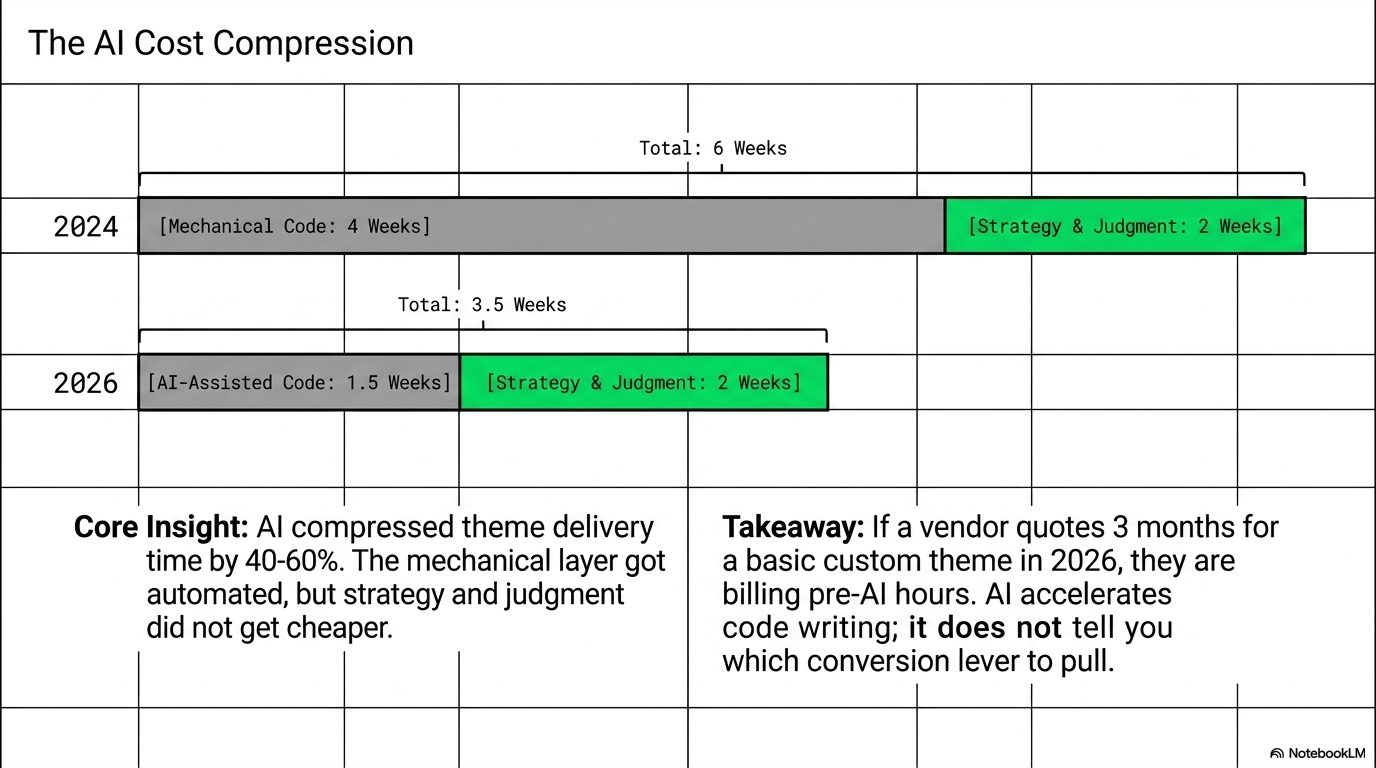
Theme work compressed by roughly 40 to 60 percent in delivery time. What used to take a senior Shopify developer three to six weeks now takes a competent operator one to two weeks (I wrote about this here). The work didn't get easier; the mechanical layer got automated. If your vendor is quoting three months for a custom theme in 2026 and they're not building anything genuinely complex, they're billing pre-AI hours.
Strategy and judgment didn't get cheaper. AI accelerates the writing of code. It doesn't tell you which feature your brand should ship next, which app belongs in your stack, or which conversion lever to pull this quarter. Vendors who charge largely for judgment haven't gotten cheaper because their input hasn't changed. If a senior solo operator is charging the same in 2026 as 2024, they're either underpaid or their AI-leverage is going into faster delivery rather than lower price.
The implication for buyers: the right vendor will deliver faster than they would have two years ago, at a similar or slightly lower price for the same scope. The wrong sign is a vendor quoting the same timeline as 2023 without any acknowledgment that the tooling has moved.
Why agencies cost more (transparently)
I want to give the agency answer fairly, because there are cases where an agency genuinely is the right vendor.
An agency at ₹10,00,000 for a build is not necessarily ripping you off. They're billing five or six people on the project — a designer, a developer, a QA tester, a project manager, an account manager, and sometimes a strategist — each at junior to mid hourly rates, plus overhead. The total is what it is.
The question is whether the brand actually needs five or six people on it. Most brands at ₹15 lakh to ₹2 crore monthly revenue don't. They need one senior person who can hold the whole picture. The agency answer is "we'll handle everything"; the operator answer is "I'll handle everything." The output can be the same. The cost difference is the org chart.
When agencies are the right call: when you're above ₹2 crore monthly revenue, when you're migrating from a legacy enterprise platform, when you need a Shopify Plus partner badge for procurement, or when your internal team is large enough that you need a vendor with matching headcount. Otherwise, the agency premium is paying for management overhead you'd manage internally anyway.
Red flags to watch for in any quote
Three patterns that signal a quote is misshapen, regardless of tier.
A quote without a scope document. "We'll build you a Shopify store for ₹3 lakh" with no scope attached means the scope gets defined later — usually mid-project, when you're already committed and the vendor knows what they can negotiate up. Real quotes come with a numbered list of what's in, what's out, and what's a change request.
Pricing that's far below the Tier 1 floor. A ₹15,000 "full custom Shopify build" is not a custom build. It's a Shopify starter theme with a colour change, sold as if it were custom. The work it represents is real and useful for a brand at the very low end, but the framing is dishonest. Real custom work doesn't fit in those numbers.
A retainer with no scope. "₹50,000 a month for ongoing support" with no hours, no deliverables, and no outcome target is a vendor billing you for being available. Retainers should be scoped — either "X hours per month, used for Y categories of work" or "we maintain this performance/conversion/release-cadence target." Without scope, the retainer is a subscription to vague reassurance.
I had a recent example where all three of these patterns showed up in one conversation. A founder came to me wanting to make a set of changes to their existing Shopify store. I asked the obvious first question — what specifically needs to change — and we couldn't get past "some changes." I floated hourly billing as a way to handle the open-ended shape. They counter-anchored at ₹1,000 an hour, which is the marketplace freelancer floor for tasks with a tight brief, not the rate for an undefined engagement on a live store. And when I tried to define the process — what an hour would buy, how I'd report it, what the decision points would look like — they pushed back on the framing itself. Three red flags stacked in one conversation: a scope they couldn't articulate, a price anchored to a tier that doesn't do the work they were actually asking for, and a buyer who wouldn't take the vendor's process on trust. I declined. The lesson works both directions — if the buyer can't articulate scope and won't accept the vendor's framing for how to define it, the engagement is going to be painful regardless of price.
What I charge — the transparent version
I run as a solo operator priced for Indian brands. I publish the band because I'd rather have the price conversation upfront than over three discovery calls — and because I sit at the accessible end of the solo operator tier, not the ceiling.
| Engagement | Range | Best for |
|---|---|---|
| Theme tweak / single feature | ₹40,000 – ₹1,50,000 ($475 – $1,800) | Brands needing a specific surgical fix |
| Custom theme build | ₹1,50,000 – ₹8,00,000 ($1,800 – $9,500) | Brands launching or replatforming |
| Shopify Plus build | ₹5,00,000 – ₹12,00,000 ($6K – $14K) | Brands scaling onto Shopify Plus |
| Migration (Woo / Magento / legacy) | ₹1,25,000 – ₹6,00,000 ($1.5K – $7K) | Brands moving to Shopify or Shopify Plus |
| Retainer | ₹40,000 – ₹80,000/mo ($475 – $950/mo) | Brands wanting ongoing improvement |
Two things to read into these numbers. First, my floor is below where most boutique agencies will pick up the phone, which is deliberate — I want to be the right answer for an Indian D2C brand at ₹15 lakh to ₹1 crore monthly revenue where a ₹10 lakh agency build genuinely doesn't fit the unit economics. Second, my ceiling is below the Tier 2 ceiling I described in the market table above. That's also deliberate: I'd rather build three brands a year at honest numbers than chase the ceiling and ship two.
Every engagement comes with a written scope before any work starts. I'm a Delhi/NCR-based solo operator working primarily with D2C brands across India, with selective work for US and UAE brands where the time zones cooperate.
How to decide what you actually need
A short decision frame, not a quiz.
- Revenue band. Under ₹15 lakh/month, Tier 1 or low Tier 2. ₹15 lakh to ₹2 crore/month, Tier 2 is the sweet spot. Above ₹2 crore/month, Tier 3 or Tier 4.
- What's broken. Performance issues, conversion issues, scaling issues — Tier 2 or 3. Specific feature missing — Tier 1 or 2. Compliance or B2B or international — Tier 4.
- How accountable is the buyer side. If you're a founder who can hold a single vendor accountable, solo operator wins on price and on focus. If you're a larger team where someone needs to manage the vendor for you, agency is fine but you'll pay for the management.
The cheapest answer is rarely the right one. The most expensive answer is also rarely the right one. The right answer is the smallest tier that can credibly hold the scope you actually need.
What's next
If you want to talk about a specific project — whether you're a founder shopping vendors or a developer figuring out your own pricing — send me a message. I do this work for D2C brands at the range described above. I'll tell you which tier I think fits you, even if it's not me.
If you want the related deeper reads:
- The honest economics of being a solo Shopify operator in 2026 — the long version of where Tier 2 pricing comes from.
- Operator mode — what the role actually is and how it differs from "Shopify developer."
- Why your Shopify store isn't getting cited — if AEO is on your mind too.
Sources:
FAQ
Frequently asked questions
How much does a Shopify developer cost in India in 2026?
For Indian brands, freelancer hourly rates run roughly ₹800 to ₹2,500 ($10 to $30 USD), solo operators ₹2,500 to ₹6,000 ($30 to $70), and agencies ₹4,000 to ₹12,000 ($50 to $145). Project pricing for a typical Shopify build starts around ₹1,25,000 ($1,500) at the freelancer floor and runs to ₹25,00,000+ ($30,000+) for a full Shopify Plus build with a mid-sized agency.What's the difference between a Shopify freelancer, a solo operator, and an agency?
A freelancer takes a defined task and ships it. A solo operator owns the entire Shopify implementation for a brand — theme, custom development, performance, conversion, often integrations and ads. An agency does the same work but with a project manager, account manager, and a team between you and the person writing the code. You usually pay 2-3x more for the org chart.Why are Indian Shopify developers cheaper than US ones?
Geographic arbitrage. The work itself is the same — Liquid, JavaScript, Shopify APIs, theme architecture. Cost of living is lower in India, so the same senior skill sells for 60 to 70 percent less than a US-based operator at the same level. Quality varies independently of price.Should I hire an agency or a solo Shopify developer for my D2C brand?
Brands under ₹15 lakh per month revenue are usually better off with a solo operator or senior freelancer. Brands at ₹15 lakh to ₹2 crore per month benefit most from a senior solo operator who can own the whole implementation. Above ₹2 crore per month you usually want either an in-house team or a Shopify Plus agency partner.How much does a Shopify Plus developer cost in India?
Shopify Plus work commands a 30 to 60 percent premium over Basic Shopify. Senior solo Plus developers in India charge ₹4,000 to ₹8,500 ($50 to $100) per hour or project rates of ₹4,00,000 to ₹25,00,000 ($5,000 to $30,000). Shopify Plus partner agencies start higher, typically ₹8,500+ ($100+) hourly and ₹8,00,000+ ($10,000+) minimum project budgets.How much does a Shopify migration cost in India?
Migrations from WooCommerce, Magento, or a legacy Shopify theme to Shopify 2.0 or Shopify Plus run ₹1,75,000 to ₹15,00,000 ($2,000 to $18,000) depending on store size, custom logic, app dependencies, and whether SEO redirects are scoped properly. The biggest pricing variable is data integrity — clean product catalogs migrate cheap, messy ones do not.What does a Shopify retainer cost in India per month?
Solo operator retainers run ₹40,000 to ₹2,50,000 per month ($500 to $3,000), depending on scope. Mid-tier agency retainers start around ₹1,00,000 per month ($1,200) and climb to ₹5,00,000+ ($6,000+). Retainers should be scoped by hours per month or by outcomes (conversion lift, performance target, release cadence) — not a vague "ongoing support" pitch.Why don't most Shopify developers in India publish their prices?
Two reasons. Project pricing genuinely varies — a ₹2 lakh build and a ₹20 lakh build are both real depending on scope. And many vendors believe that publishing rates removes their ability to charge what the buyer can bear. I publish my range because the buyers I want to work with prefer legible pricing over discovery-call theatrics.
Revision history· 2 entries
June 22, 2026
Initial post. Numbers are conservative working estimates from my own pricing, what I see in the Indian Shopify market in 2026, and public data from Clutch, Upwork, and the Shopify Partner Directory.
June 22, 2026
Added Audio Overview option to help readers.
Last updated September 19, 2026