AEO vs SEO vs GEO, explained for D2C founders who don't have time for jargon
Three acronyms, one real question: will your brand show up when a customer goes looking, whether that's Google or an AI? Here's the plain version, with no consultant fog

Listen to this article
AEO vs SEO vs GEO, explained for D2C founders who don't have time for jargon
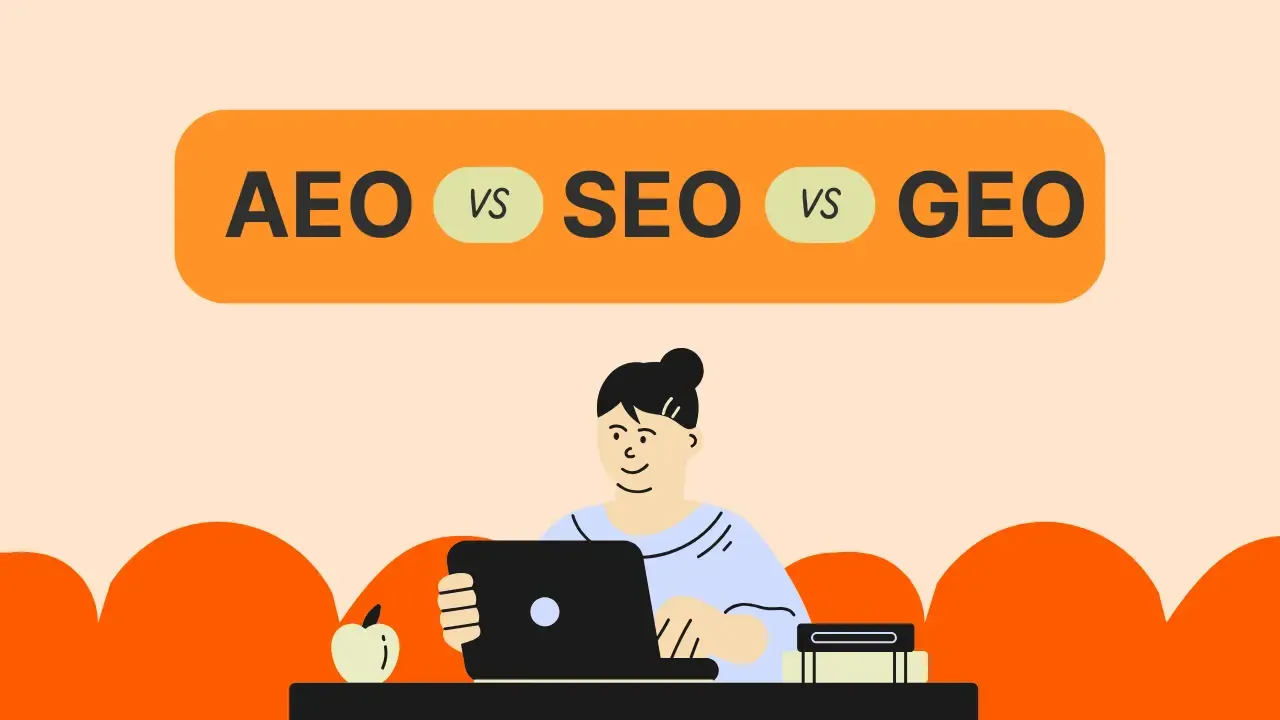
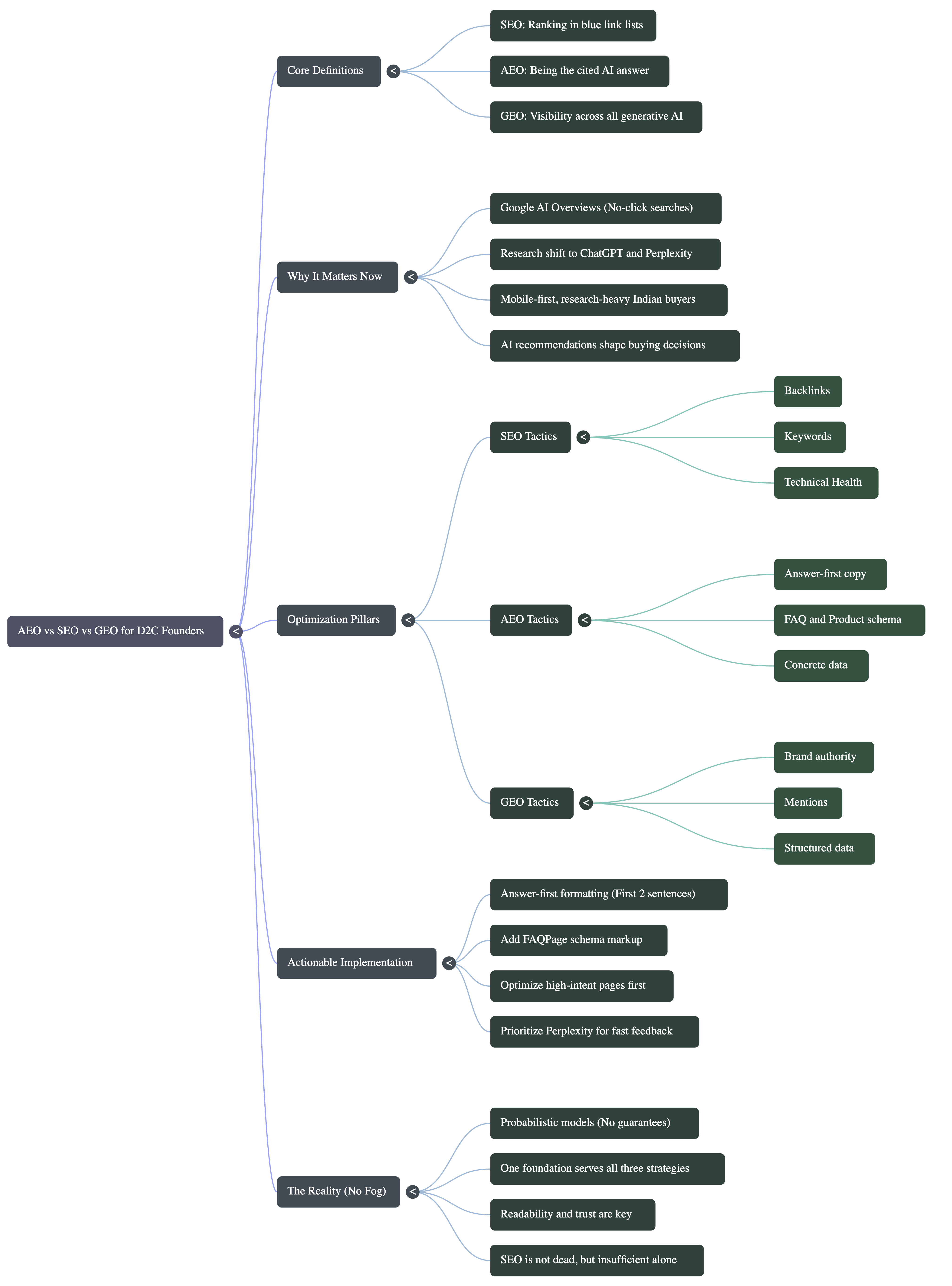
Here's the whole thing in three sentences. SEO gets your page into a list of blue links someone has to click. AEO gets your brand named as the answer an AI hands back, before any links show up. GEO is the bigger umbrella, getting your brand surfaced and recommended across AI tools generally, and AEO is the slice of it that's specifically about being the cited answer. They run on the same plumbing, but they aim at different finish lines, and in 2026 a D2C brand needs all three.
I'll be straight with you about why I bothered writing this. I sat in a sales call a few months ago where a founder told me her "SEO guy" had pitched her on "GEO and AEO services" for an extra retainer, and she had no idea if she was being sold something real or being upsold fog. The concepts are real. A lot of the packaging around them is fog. So let me strip it down.
The definitions, without the padding
SEO, search engine optimization, is the old game. You want Google to rank your page near the top of the results for a search, so the person clicks your link instead of someone else's. This still drives a lot of traffic, especially in India where plenty of buying journeys still start on Google.
AEO, answer engine optimization, is the new game on top of it. When someone asks ChatGPT or Perplexity a question, the AI doesn't hand back ten links, it writes one answer and cites a few sources. AEO is the work of being one of those cited sources, ideally the one whose product or brand gets named.
GEO, generative engine optimization, is the umbrella term for showing up well across all the generative AI surfaces, in answers, in comparisons, in recommendations. AEO lives inside it. Honestly, people use AEO and GEO almost interchangeably in conversation, and that's fine. Don't let anyone make the distinction sound more profound than it is.
Why this matters now, and why it matters more in India
Two shifts are happening at the same time. Google now shows an AI-generated summary on a sizeable share of searches — its own guidance treats AI Overviews and AI Mode as core surfaces, not experiments (Google's AI features optimization guide) — which means even on Google a lot of people get their answer without clicking anyone. And separately, a growing share of research has moved into ChatGPT and Perplexity entirely. Put those together and you get the same uncomfortable conclusion: a lot of buying decisions are now being shaped in a place where there is no blue link to rank for.
For an Indian D2C brand this hits a particular nerve. Your buyer is mobile-first, price-sensitive, and does a surprising amount of research before committing, especially on COD where there's no money down to create commitment. If that research now happens inside an AI that recommends one brand, being the recommended brand isn't a nice-to-have. It's the whole ballgame for that customer.
How they actually differ in practice
Here's the comparison I wish that founder had been shown instead of a quote.
| SEO | AEO | GEO | |
|---|---|---|---|
| Goal | Rank in the link list | Be the cited answer | Be recommended across AI |
| What moves the needle | Backlinks, keywords, technical health | Answer-first copy, FAQ and Product schema, concrete data | Brand authority, mentions, structured data, all of AEO |
| Where you show up | Google results page | ChatGPT, Perplexity, Google AI Overviews | Every generative surface |
| How fast you see change | Weeks to months | Days on Perplexity, weeks elsewhere | Weeks |
The honest takeaway from that table is that the columns overlap more than the acronyms suggest. A page that loads fast, is cleanly structured, carries accurate schema, and is genuinely useful does well in all three at once. You are not running three separate programs. You're building one solid foundation and tilting it toward AI.
The Princeton GEO study at KDD 2024 (paper) ran nine optimization tactics across generative engines and found that two things move the needle hardest: adding cited sources lifted citation rate by roughly forty percent, and adding specific statistics by roughly thirty-seven. Keyword stuffing — the old-SEO crutch — actually reduced AI visibility by about ten percent. The fastest way to get cited by an AI is to write content the AI can quote.
A real example, so this stops being abstract
Let me run one question through all three, because the difference only clicks when you see it.
Say you sell magnetic lashes, and your best customer is a woman with sensitive eyes who wants something that ships fast in India. On the old SEO path, she Googles "best magnetic lashes for sensitive eyes," sees a results page, and your job was to rank high enough that she clicks you out of ten options. You got a shot at her attention. She still did the choosing.
Now she opens ChatGPT and types "what are the best magnetic lashes for sensitive eyes that ship fast in India." ChatGPT doesn't show ten options. It names two or three brands and explains why. This is the AEO layer. If your product page clearly says it's designed for sensitive eyes, carries reviews from people who said the same, and has clean Product schema the model can read, you're a candidate to be named. If your page says "premium magnetic lash system with advanced adhesive technology," you're invisible, because nobody asked for that and the model can't map it to her question.
The GEO layer is the wider pattern across all of it. Has your brand been mentioned enough places, structured well enough, and reviewed credibly enough that across ChatGPT, Perplexity, Gemini, and Google's AI Mode you keep surfacing as a name that belongs in this category. SEO got you into the race. AEO gets you named in the answer. GEO is whether the whole ecosystem already thinks of you as an answer worth giving.
Same brand, same product, three different jobs. That's why you can't pick one.
How to check where you actually stand in 20 minutes
You don't need a tool or a consultant to get a first read. You need 20 minutes and some honesty. Here's the self-check I'd run on any store.
Open your yourstore.com/robots.txt in a browser and read it. Look for any line that disallows crawlers like OAI-SearchBot, GPTBot, ClaudeBot, or PerplexityBot. If they're blocked, you've turned yourself off in those engines and nothing else you do matters until that's fixed.
Next, open one of your top product pages, right-click, view page source, and search the source for application/ld+json. If you find a Product block with a name, price, and availability, good. If you find nothing, or you only find it after the page fully loads in the browser but not in the raw source, your schema isn't there or isn't readable by the bots. Both are fixable.
Then do the part that actually stings. Go to ChatGPT and Perplexity and ask the three questions your best customer would ask before buying from you. Not your brand name, the category questions. "Best [your category] for [your customer's need] in India." See if you show up. See who does. Run each a few times, because these models don't answer identically twice. Write down where you appear, where your competitors appear, and what the AI says about each of you.
That last step is uncomfortable and it's the most useful 10 minutes you'll spend this month. Most founders have never once asked an AI the question their customer is asking, and they're shocked by who gets named instead of them.
The mistakes I see most often
A handful of errors come up again and again, and they're worth naming because each one is a quiet leak.
The first is the blocked crawler I keep mentioning, usually added by an app or a past developer and never noticed. The second is schema that only renders after JavaScript runs, so the page looks fine to you in the browser but the bot sees an empty shell. Render it server-side. The third is product copy written for a keyword instead of a question, the "premium engineered footwear" problem, where the page describes the product in language no human ever types into a search box.
The fourth is treating reviews as decoration. AI engines lean on reviews because they're a trust signal that updates itself, so burying them in a widget the crawler can't read throws away one of your strongest assets. The fifth is the one I'd call the founder's trap: chasing the shiny AEO tactics while the basics are broken. There's no point monitoring your ChatGPT citations if your robots.txt is blocking ChatGPT. Fix the floor before you decorate the walls.
So what do you actually do, if you do one thing
Take your highest-intent pages, the ones where someone is close to buying, and do two things. Put the direct answer to the page's core question in the first two sentences, in plain language. Then add a real FAQ marked up as FAQPage. That single move helps your AEO immediately, supports any featured-snippet chances you still have in Google, and costs you nothing but the discipline to write clearly. I've watched that one change start pulling pages into Perplexity answers inside a week.
Everything fancier than that, the schema audits, the citation monitoring, the topical-authority content clusters, is worth doing. But if you only have the energy for one thing this month, answer-first plus FAQ is the move with the best return.
Where this is heading, so you're not optimizing for yesterday
The ground is still moving, and two shifts are worth watching. The first is agentic shopping. The AI is starting to not just recommend a product but compare options, check availability, and in some cases move toward buying on the shopper's behalf. An agent doing that needs clean, machine-readable product data even more than a human reader does, which means the structured-data work you do now pays off harder later. The second is that Google's AI Mode is turning search into something closer to a conversation than a list, so the brands that win are the ones that read as a trustworthy, well-structured source the model is comfortable quoting.
None of this changes the fundamentals. Be readable, be structured, be trustworthy. It just raises the stakes on getting them right.
The part nobody selling you "GEO services" will say out loud
You cannot fully control whether an AI recommends you. These models are probabilistic. They'll give a slightly different answer to the same question on Tuesday than they did on Monday. Anyone promising you a guaranteed spot in ChatGPT is selling you the fog. What you can do is stack the odds heavily in your favor by being the most readable, most structured, most trustworthy source in your category. That's it. That's the real work, and it happens to be the same work that makes you better at regular SEO too.
Want to see where your own store stands on all three? Audit your Shopify theme for SEO, AEO, and GEO — free Claude Code skill, dual-scored verdict in 90 seconds.
If you want help figuring out where your brand currently stands across these engines, that's a thing I do. Send me your store and the three questions your best customer would ask an AI, and I'll tell you whether you show up.
FAQ
Frequently asked questions
Is SEO dead now that AI answers everything?
No. SEO still drives a large share of traffic, especially in India, and it shares its technical foundation with AEO. It's no longer sufficient on its own, but it's far from dead.What's the actual difference between AEO and GEO?
GEO is the broad practice of optimizing for generative AI across answers, comparisons, and recommendations. AEO is the specific slice focused on being the cited answer. In practice the terms are often used interchangeably.Which AI engine should a D2C brand optimize for first?
Perplexity, because it shows the effect of changes within days and displays its citations, making it the fastest feedback loop before you optimize for slower engines.Do I need separate content for SEO and AEO?
No. One well-structured, schema-backed, genuinely useful page can serve both. You layer AEO tactics like answer-first formatting and FAQ schema on top of solid SEO, rather than writing twice.Can an agency guarantee my brand gets recommended by ChatGPT?
No honest one can. The models are probabilistic and vary their answers. What's real is improving your odds through structure, schema, and authority, not a guaranteed placement.
Revision history· 1 entry
June 07, 2026
Added Audio Overview option to help readers, added mindmap for more clarity of the topic.
Last updated June 07, 2026