How D2C brands actually show up in ChatGPT and Perplexity in 2026
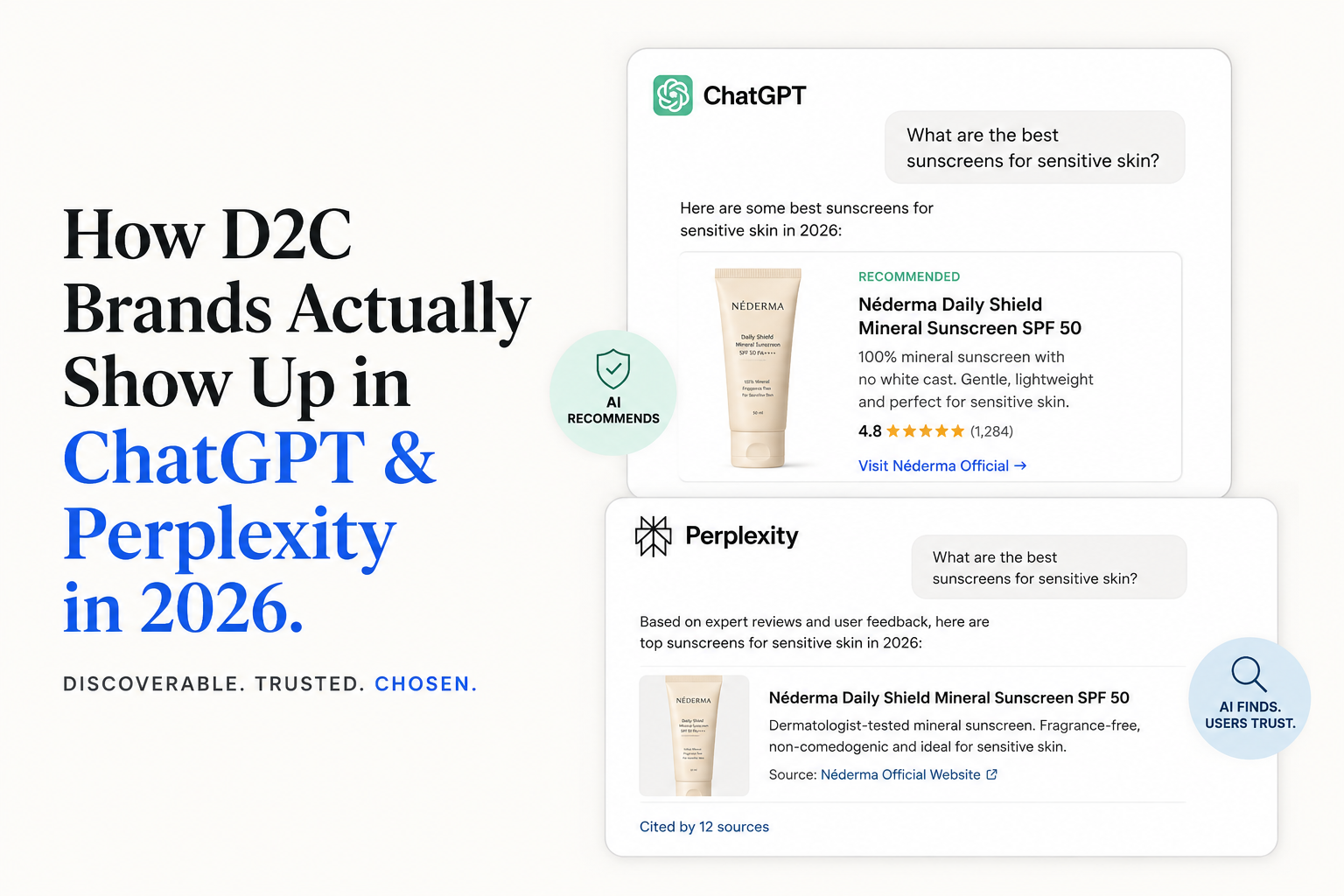
Your customer asks ChatGPT for the best brand in your category and gets two names. If you're not one of them, you don't exist for that customer. Here's what determines which D2C brand gets named, ranked by what you can actually change this week.

Here's the whole thing in three sentences. When your customer asks an AI for the best brand in your category, you either get named or you don't, and the AI's choice depends on three things you can actually influence. The three are clean structured data on your own pages, mentions on the third-party sites the AI trusts, and clear positioning that maps to the question your customer asked. This post is the ranked playbook for moving on each of them.
What's actually happening when your customer asks an AI
Your customer used to type a search into Google. Google returned ten links. Your job was to rank in the ten. Even at rank seven, you got a shot.
In 2026, a growing share of buying research starts inside ChatGPT, Perplexity, or Google's AI Mode. The customer types the question. The AI returns one paragraph. Two brands are named. Nobody else exists.
The shift sounds dramatic and the practical effect is bigger than it sounds. The number of brands in the consideration set has shrunk from "the first page of Google" to "the names the model decided to mention." If you're not named, you don't lose to rank seven. You don't lose at all. You're just not in the room.
Three things determine whether your brand gets named
Strip the fog and there are three real inputs.
One. What the AI can read directly from your site. Your structured data, your copy, your robots.txt, your sitemaps. If the AI can't crawl you, or it can crawl you but doesn't understand what you sell, you're invisible. This is the part you control completely.
Two. What the AI reads about you elsewhere. Reviews on Trustpilot. Mentions on Reddit. Comparisons on review sites. Discussions on Indie Hackers or Twitter. The AI weights these heavily because they're harder to fake than your own site. This is the part you influence over time.
Three. How specifically your positioning matches the question. A brand selling "premium athletic footwear" is invisible to the question "best running shoes for plantar fasciitis under five thousand rupees." A brand explicit about that exact use case wins. This is the part most founders skip because they don't want to narrow the audience.
Order matters. Fix one before two. Fix two before three has full effect. But all three compound, and the brands winning in AI citations work on all three at once.
Self-check in 20 minutes
Before you change anything, see where you stand. This is the same check I wrote about in the AEO vs SEO vs GEO post, applied specifically to a D2C brand.
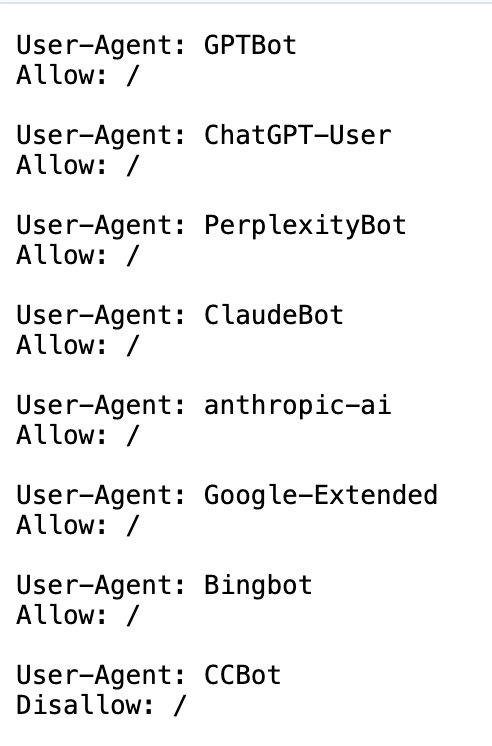
Open yourstore.com/robots.txt in your browser. Look for lines that disallow OAI-SearchBot, GPTBot, ClaudeBot, PerplexityBot, or similar. If any are blocked, you've turned yourself off in those engines and nothing else matters until that's fixed. Apps often add these lines without telling you.
Open one of your best-selling product pages. View source. Search for application/ld+json. You should find a Product block with name, price, availability, and ideally images and reviews. If there's nothing, your product is invisible to structured-data crawlers. If the block only appears after JavaScript runs, server-render it.
Now do the painful part. Open ChatGPT and Perplexity. Ask the three questions your best customer would ask before buying. Not your brand name — the category question. "Best magnetic lashes for sensitive eyes that ship fast in India." "Best cold-pressed olive oil under fifteen dollars." Write down which brands the AI names. Run each query three times because the answer drifts.
Most founders do this exercise once and are surprised. The brands the AI names are not always the brands the founder thought were the competition.
Fix one. Make your site machine-readable
Three changes, in order.
Unblock the crawlers. Update robots.txt to allow OAI-SearchBot, GPTBot, ClaudeBot, PerplexityBot, Google-Extended, and Applebot-Extended. This is a one-line fix per crawler. It is the single highest-leverage change.
Add Product schema to every product page. If you're on Shopify, this is partially handled by your theme but often incomplete. The Product block should include name, description, image, brand, sku, gtin if applicable, offers with price and priceCurrency and availability, and ideally an aggregateRating if you have real reviews. Server-rendered, not JavaScript-injected.
Add FAQ blocks to your high-intent pages. Pricing page. Sizing page. Shipping policy. Each should carry a small FAQPage block answering the questions a buyer asks before purchasing. This is the single most effective thing for being cited as the answer to a question.
This is the cheapest cluster of work and the most reliable to ship. Most stores can do it in a week with a developer or in two weeks of part-time work without one.
Fix two. Get mentioned on the sites the AI trusts
This is where most brands give up because it can't be checklist-shipped in a week. It's the slower compound game.
The sites that matter most for D2C in 2026 are Trustpilot for general reviews, Reddit for category discussion, Amazon for product reviews if you sell there, Quora for question-shaped traffic that the AI re-reads constantly, and Indie Hackers or Twitter for niche credibility. There are domain-specific sites too — Wirecutter for tech and home, Healthline for supplements, Outdoor Gear Lab for outdoor.
The work isn't "get featured on Wirecutter." That's a different game. The work is "be present in the discussions that your customer is having and the AI is reading." Answer questions on Quora. Show up in Reddit threads when the question is genuinely in your domain. Ask happy customers for Trustpilot reviews after they receive the order. The AI weights signed, third-party signal heavily.
A small brand that shows up in five Reddit threads over a month gets cited more than a big brand that does no outreach. The AI is reading those threads either way.
Fix three. Position so specifically that the AI can't paraphrase you out
This is the part most founders won't do. They have an instinct that narrow positioning loses sales. The opposite is true in AI search.
The AI takes your category claim and tries to match it to the customer's question. "Premium athletic footwear" matches almost no real questions. "Running shoes for over-pronation under three thousand rupees" matches a specific question. The narrower brand wins that specific question. Across a category, narrow brands win because they own a question each. Broad brands win none.
Take your category. Write down the top ten questions a customer asks before buying. Not the top ten you wish they asked. The top ten they actually ask. Position your brand explicitly for one of them on your homepage and your category page. Do it the way a human would say it, not the way a press release would.
What the AI will not tell you about why you're not cited
It will not tell you you're blocked. It will not tell you your schema is broken. It will not tell you the competitor it cited has a Trustpilot rating two points above yours. The AI just gives the answer it gives, and the reason it didn't name you is invisible.
This is why the self-check matters more than reading content like this post. You have to actually ask the AI the questions your customer asks, and write down what comes back, and compare it to what you'd want. Then you reverse-engineer the gap.
What I'd do this week if I owned a D2C brand
In order, with the ROI math:
Day one. Open your robots.txt. Unblock all AI crawlers if blocked. Five minutes of work, potentially category-changing.
Day two and three. Add Product schema to your top ten product pages if it's missing or incomplete. A day of developer time. Visible in Perplexity within a week.
Day four and five. Add FAQPage blocks to your top three high-intent pages — pricing, sizing, shipping. Half a day of work. Moves your pages into Perplexity citations on question-shaped searches.
Week two. Start the third-party work. Pick three sites your customer reads — usually Reddit, Trustpilot, and one category-specific site. Show up in genuine ways for two weeks. Don't spam. Be useful.
Week three. Re-run your AI self-check. Same questions, three times each. Note the change. Adjust positioning where you're still invisible.
Sources and where to learn more
If you want a deeper read on the underlying theory of AEO and GEO, the foundational post here covers the framework that this post applies specifically to D2C commerce.
If you want me to run the self-check on your brand and tell you exactly where you're invisible, send me your store URL and the three category questions your best customer would ask. I'll send back a report.
Sources:
FAQ
Frequently asked questions
How do D2C brands get cited by ChatGPT or Perplexity?
AI engines cite brands based on a combination of clean structured data on the brand's own pages, mentions and reviews on third-party sites they trust, and clear category positioning that maps to common customer questions. A brand without structured product data and without third-party mentions is invisible to these engines.Can I pay to be recommended by ChatGPT?
No. There is no advertising slot inside the answer ChatGPT or Perplexity hands back. You can pay for SEO consulting and AEO consulting, but anyone promising a guaranteed mention by the AI is selling fog. The models are probabilistic and the rankings shift.Which AI engine should a D2C brand optimise for first?
Perplexity. It re-indexes faster than other engines, shows its citations transparently, and you can see the effect of changes within a week. Optimise for Perplexity first, then ChatGPT, then Google AI Overviews. The work is similar but the feedback loop on Perplexity is the fastest.How long does AEO take for a D2C brand to show results?
Perplexity citations can appear within a week of fixing the structural issues. ChatGPT mentions take longer because the model updates its memory less frequently. Google AI Overviews take two to four weeks. Most brands see meaningful change within thirty days if they fix the basics.What is the single biggest reason a D2C brand is not getting cited?
A robots.txt that blocks AI crawlers like OAI-SearchBot, ClaudeBot, or PerplexityBot. This is the most common silent failure. It is often added by an app or a previous developer and never noticed. If you are blocked, no other optimisation matters until you fix it.Do reviews on Amazon or Trustpilot count for AEO?
Yes. AI engines weight third-party review signals heavily because they are harder to fake than self-published claims. Reviews on Trustpilot, Reddit, Amazon, and other domains the model trusts feed directly into whether your brand gets named. Self-published reviews on your own site count less.Does Schema.org markup help with AEO for Shopify stores?
Yes. Product, FAQPage, and Organization schema make your brand machine-readable in a way the AI can extract directly. Without structured data, the AI has to infer your category, price, and availability from prose, and it often gets it wrong or skips you.Will a small D2C brand ever beat a big one in AI citations?
Yes, in narrow categories. The category "best running shoes" is dominated by large brands the model knows by reputation. The category "best running shoes for plantar fasciitis under five thousand rupees" is open. The smaller the category, the more leverage a small brand has if it positions explicitly.
Revision history· 1 entry
June 17, 2026
Initial post. Applies the AEO and GEO framework to D2C commerce specifically, with the ranked checklist of what to fix this week.
Last updated June 17, 2026