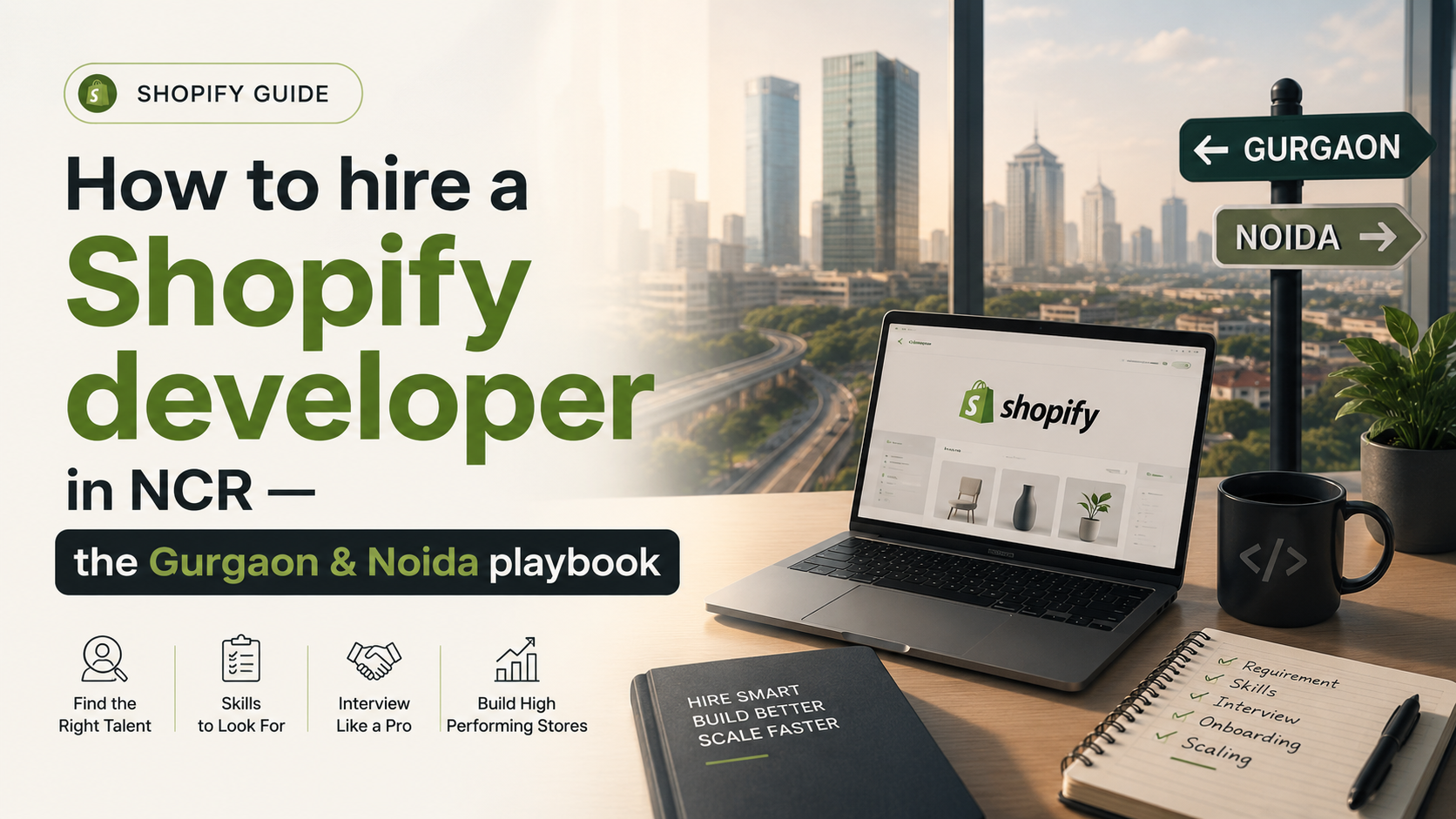
How to hire a Shopify developer in NCR — the Gurgaon & Noida playbook
Hiring a Shopify developer in Gurgaon, Noida, Faridabad, or Ghaziabad is a different shopping trip than hiring one in central Delhi. Here's what the NCR market actually looks like in 2026, what each tier costs, and how to scope the brief before you call a single vendor.

Here is the whole thing in two sentences. Hiring a Shopify developer in NCR — Gurgaon, Noida, Faridabad, Ghaziabad — is not a different exercise from hiring one in central Delhi, because the talent pool is regional. The mistake is shopping by micro-location instead of by tier, which is the single decision that determines whether the project ships clean or drags into a six-month re-engagement.
I work from Delhi/NCR. I have shipped Shopify stores for brands in Gurgaon, Noida, and across India, the US, the UK, and the UAE. This is the buyer's guide I wish more NCR founders had read before sending me the half-built theme another vendor left them with.
Why hiring in NCR feels different — and why it mostly is not
NCR founders often start the search with a location filter. They want a "Shopify developer in Gurgaon" or a "Shopify developer in Noida" because they imagine an in-person kickoff in Cyber Hub or a coffee in Sector 18 is going to de-risk the engagement.
It rarely does. The Shopify developers in NCR who are worth hiring at the senior solo or boutique tier work remote-first because that is how their clients work. The agencies with real Gurgaon or Noida offices are mostly Tier 3 and Tier 4 — they fit brands at ₹2 crore plus monthly revenue, not the ₹15 lakh to ₹1 crore band where most NCR D2C lives.
So the filter you actually want is tier, not pin code. Get the tier right and the vendor inside it is a much smaller decision.
If you have not read the four-tier pricing breakdown for India yet, start there. It is the framework this post is built on.
The four tiers, applied to an NCR buyer's decision
There are four tiers of Shopify developer working the NCR market. Each one fits a different shape of brand. Getting the tier wrong is the most expensive single mistake a founder can make at the hiring stage.
Tier 1 — Marketplace freelancer (₹50,000 – ₹2,50,000 per project). Found on Upwork, Fiverr, or Indian freelance boards. Best for: a specific, tightly-scoped task on a store that already exists. A theme tweak, a single feature, an app configuration. Wrong for anything you cannot write the brief for in a single paragraph.
Tier 2 — Senior solo operator / senior freelancer (₹1,50,000 – ₹15,00,000 per project). A senior person who owns the full Shopify implementation for your brand. Best for: D2C brands at ₹15 lakh to ₹1 crore monthly revenue who want senior hours and a single point of accountability without paying for an agency org chart. This is the tier I work in, and it is the tier most NCR brands are mis-buying around.
Tier 3 — Boutique Gurgaon or Noida agency (₹5,00,000 – ₹25,00,000 per project). Five to fifteen people in a Gurgaon, Noida, or Cyber City office. Best for: brands that want a single vendor for both design and development with a project manager owning the timeline. Real value above ₹50 lakh monthly revenue when parallel workstreams justify the overhead.
Tier 4 — Shopify Plus partner / enterprise agency (₹10,00,000 – ₹1 crore plus). Twenty-plus people, verified Shopify Plus partner status. Best for: brands above ₹2 crore monthly revenue, enterprise migrations, or international brands moving onto Shopify Plus from another platform.
The single most common mistake I see in NCR is brands at ₹20 lakh monthly revenue hiring a Tier 3 boutique because the founder used to work at a larger company and is anchored on enterprise pricing. They overspend on an agency that treats them as a small account. The right answer for that brand is almost always Tier 2.
The second most common mistake is brands at ₹3 crore monthly revenue hiring a Tier 1 marketplace freelancer because the WhatsApp quote was attractive. They underspend on a vendor who cannot hold the scope they actually need. The right answer for that brand is Tier 3 or Tier 4.
Get the tier right first. The vendor inside the tier is a smaller, cheaper decision.
Gurgaon vs Noida vs Faridabad vs Ghaziabad — does it matter?
Practically, no. The Shopify talent pool in NCR is regional. A senior solo operator based in Noida will quote the same range as one based in Gurgaon for the same scope, because they are pricing against the same client base — D2C brands across India and the diaspora.
The only place micro-location actually matters is Tier 3 and Tier 4, where you want regular in-person presence with a project manager. Even then, Gurgaon and Noida have largely converged on price. The agency overhead is the agency overhead, regardless of which side of the Yamuna it sits on.
If you have a hard preference for an in-person meeting, ask for one. Do not let it narrow your shortlist past three vendors per tier. The cost of buying a less-senior developer to get the Gurgaon office address is usually higher than the cost of two Uber rides to a coworking space when you actually need one.
The ten questions to ask any NCR Shopify developer
These are the same ten questions I would ask any Shopify developer in India. The good ones welcome all ten. The bad ones get defensive around question six or seven, which is the actual point of asking.
- What is your floor and ceiling on this kind of project? Anyone who cannot quote a range is either hiding their pricing or has not done enough of this work to know.
- What is in the scope and what is a change request? Forces a written scope conversation before money moves.
- Will you scope this in writing before we start any work? Non-negotiable. If they say "we will figure it out as we go," walk.
- Which apps will you install and which will you build around? Tests whether they understand the trade-off between apps (fast, recurring cost, vendor risk) and custom code (slower upfront, owned by you).
- What is your Lighthouse target for mobile? A senior developer in 2026 will name a specific number. A shrug means they do not have a process for it.
- How do you handle Core Web Vitals? Real answer talks about LCP targets, image strategy, and Liquid render order — not a generic "we optimise for speed".
- What is the deployment plan, and will I have access to the staging environment? You should always own the staging store under your Shopify Partners or Plus account.
- Who else will touch this project? Tier 2 should say "me." Tier 3 and Tier 4 should name the team. Tier 1 sometimes outsources to a sub without telling you — ask explicitly.
- What happens if I find a bug after launch? Real answer includes a defined warranty window. "We will fix it" without a timeframe becomes a billing argument later.
- Will you sign the work over to me at the end? Code ownership, theme files, custom apps, design files. Get it in writing before any deposit moves.
Clean confident answers to at least eight of the ten means the vendor is worth the next conversation. Vague or defensive answers to more than three means they are not.
Red flags specific to the NCR Shopify market
Some red flags are universal. These are the ones I see show up in Gurgaon, Noida, and across NCR specifically.
A Gurgaon or Noida address that turns out to be a coworking lobby. Common in low-tier listings. The "office" is a day-pass at a coworking space booked once, photographed, and never used again. Ask for the registered GST address on the invoice and a video walkthrough of the workspace. A vendor who cannot show the office should not be billed as a vendor with one.
WhatsApp-only communication, no GST invoice, no written agreement. Common at the Tier 1 floor across NCR. The price feels right because there is no GST and no overhead, but you have no legal recourse when the project goes sideways, and you cannot claim the spend against your business. Walk.
A portfolio of unnamed projects with no live store URLs. Almost universal in low-end NCR listings. "We built 50+ Shopify stores" with thumbnails and no live links means you cannot verify a single project was actually built by this vendor. Real portfolios link to the live store so you can open it in BuiltWith and see for yourself.
Claims of Shopify Partner status that do not check out. Search the developer or agency name on the Shopify Partner Directory. If they are not in it, they are not a Shopify Partner — the directory is the only valid source. A handful of NCR vendors put "Shopify Partner" on their site without ever having applied for or maintained the status.
Pricing significantly below the market floor for the scope. A ₹25,000 "full custom Shopify theme" in 2026 is not custom work. It is a starter theme with a colour change. The work it represents is real for a very small brand, but the framing is dishonest and that dishonesty usually shows up mid-project as scope drift.
A three-sentence quote on WhatsApp. Real Shopify scopes run two to four pages because there are genuinely that many decisions to make. A quote without a scope document means the scope will be defined mid-project, when you are already committed and the vendor knows what they can negotiate.
How to scope the NCR brief before you talk to anyone
A clean brief gets you better quotes from better vendors. A vague brief gets you wide quotes from every vendor willing to make something up to fill the gap.
The brief should fit on one page and answer five questions:
- What is the brand, what does it sell, and what is the monthly revenue band. This signals what tier you should be shopping in.
- What do you want at the end of this engagement. "A custom theme that does X, Y, and Z" beats "we want a beautiful website".
- What is the budget range. If you do not say it, vendors will quote what they think you can pay, not what the work costs.
- What is the timeline, and is it negotiable. A non-negotiable launch date should be flagged. A soft target should be said too.
- What does success look like in numbers. Conversion rate, AOV, mobile Lighthouse, traffic recovery after migration. Pick one or two metrics and write the target down.
Send the same brief to every vendor on your shortlist. The quotes will be comparable. The quality differences in how vendors interpret the brief — what they push back on, what they add, what they cut — will tell you more about who they are than any portfolio.
What hiring right looks like in NCR
The pattern that ships clean: a one-page brief, a written scope, a defined budget band, a specific success metric. Three vendors per tier on the shortlist. Five working days to return a written quote with a scope document attached. The middle quote in a three-vendor tier shortlist is usually the right one, because the middle is where the honest scope lands. The lowest quote is almost always interpreting the scope thinner than you mean. The highest quote is almost always interpreting the scope wider than you need.
The pattern that fails: a verbal brief, a WhatsApp quote, no scope document, a vendor selected on price alone. The first ₹50,000 of "savings" reappears as a ₹2,00,000 mid-project change request because nothing was written down and nothing can be enforced.
If you have not read the deeper buyer's guide for the Delhi market, much of the playbook there applies in NCR too — same tiers, same questions, same red flags, with the micro-location twist this post covers.
Decision frame for NCR
A three-question filter to lock the tier before you start shortlisting NCR vendors.
- Is your monthly revenue under ₹15 lakh? Tier 1 or low Tier 2. Skip the Gurgaon agencies.
- Is your monthly revenue ₹15 lakh to ₹2 crore? Tier 2 — a senior solo operator. This is the dominant shape of NCR D2C and the tier most often mis-bought.
- Is your monthly revenue above ₹2 crore, or do you need a Shopify Plus partner badge for procurement? Tier 3 or Tier 4.
Once the tier is locked, the brief gets written, the shortlist gets pulled, and the ten questions get asked. That sequence is the difference between a Shopify build that ships in eight weeks and one that drags into a six-month re-engagement across three vendors.
What is next
If you are at the Tier 2 shape — an NCR-based D2C brand at ₹15 lakh to ₹1 crore monthly revenue — and want to talk about what your project actually looks like, the Shopify developer in Delhi page has the case studies, transparent pricing, and a 30-minute call link. I work across Gurgaon, Noida, Faridabad, Ghaziabad, and central Delhi. I will tell you what the scope should be, what the realistic timeline is, and whether I am the right vendor for it. If I am not, I will tell you who is.
If you want the related deeper reads:
- How to hire a Shopify developer in Delhi without getting burned — the broader buyer's guide for the Delhi market this NCR post extends.
- The honest cost of hiring a Shopify developer in India in 2026 — the four-tier pricing framework this post is built on.
- The honest economics of being a solo Shopify operator in 2026 — what Tier 2 actually does and how the role works.
Sources:
FAQ
Frequently asked questions
Where do I find Shopify developers in NCR — Gurgaon, Noida, or Faridabad?
The listing sites surface Gurgaon agencies, not solo operators. The Shopify Partner Directory is the only verifiable source for partner status, but it skews toward larger agencies. Most senior NCR freelancers and solo operators are found through LinkedIn searches filtered by Delhi/NCR location and Shopify experience, through referrals from other D2C founders in the same revenue band, and by reading their long-form writing on Shopify before reaching out.Is a Gurgaon Shopify developer more expensive than a Noida or Delhi one?
Not meaningfully, in 2026. Pricing in NCR is set by tier (marketplace freelancer, solo operator, boutique agency, Shopify Plus partner), not by micro-location inside the region. A senior solo Shopify operator in Gurgaon, Noida, Faridabad, Ghaziabad, or central Delhi will quote inside the same ₹1.5 lakh to ₹15 lakh band for a custom theme build, because the work and the talent pool are regional, not neighbourhood-level.Should I prefer an in-person meeting in Gurgaon or Noida, or work remote?
For most D2C engagements at ₹15 lakh to ₹1 crore monthly revenue, remote with one or two in-person kickoffs is the right shape. Asking for a daily on-site presence in Gurgaon or Noida narrows your shortlist to the handful of agencies with bench staff in that micro-location and removes the senior solo operators who would otherwise be your best fit. Buy the seniority, not the commute.How do I verify a Shopify developer's Gurgaon or Noida office is real?
Most listings claiming a Gurgaon or Noida office are coworking-day-pass addresses or PG numbers used to rank in local SERPs. Ask for the registered GST address on the invoice, cross-check against the company's Ministry of Corporate Affairs filing, and request a video walkthrough of the workspace before paying any deposit. A vendor unwilling to show the office should not be billed as a vendor with one.What does a Shopify project in NCR actually cost in 2026?
For a custom Shopify theme in 2026, expect ₹50,000 to ₹2,50,000 from a marketplace freelancer, ₹1,50,000 to ₹8,00,000 from a senior solo operator, ₹5,00,000 to ₹15,00,000 from a Gurgaon or Noida boutique agency, and ₹10,00,000 plus from a Shopify Plus partner. Numbers below the freelancer floor are usually a starter theme sold as custom, or a developer who has not priced the work honestly.Which is better for a D2C brand in NCR — solo operator or agency?
For brands at ₹15 lakh to ₹1 crore monthly revenue — the dominant shape of NCR D2C — a senior solo operator delivers the same scope as a boutique Gurgaon agency at a lower price, with senior hours end-to-end instead of a junior wrapped in project management. Agencies make sense above ₹2 crore monthly, when you genuinely need parallel design and development, or when a Shopify Plus partner badge is required for procurement.What red flags are specific to the NCR Shopify market?
Four show up repeatedly. A Gurgaon or Noida address that turns out to be a coworking lobby. WhatsApp-only communication with no GST invoice. A portfolio of unnamed brands with no live store URLs. Pricing more than thirty percent below the next quote in the same tier, which usually means the scope is being interpreted differently than you think.How fast can I hire a Shopify developer in NCR?
Two to three weeks from first conversation to signed scope is the honest fast path. One week to write the brief and shortlist three vendors, one week to take calls and check references, and a few days for the scope round and contract. Faster than two weeks usually means a step was skipped and the cost shows up mid-project.
Revision history· 1 entry
June 28, 2026
Initial post. NCR-specific buyer's guide — Gurgaon, Noida, Faridabad, Ghaziabad — built on the same four-tier framework as the Delhi and India-cost posts.
Last updated June 28, 2026